
My First SDS Conference
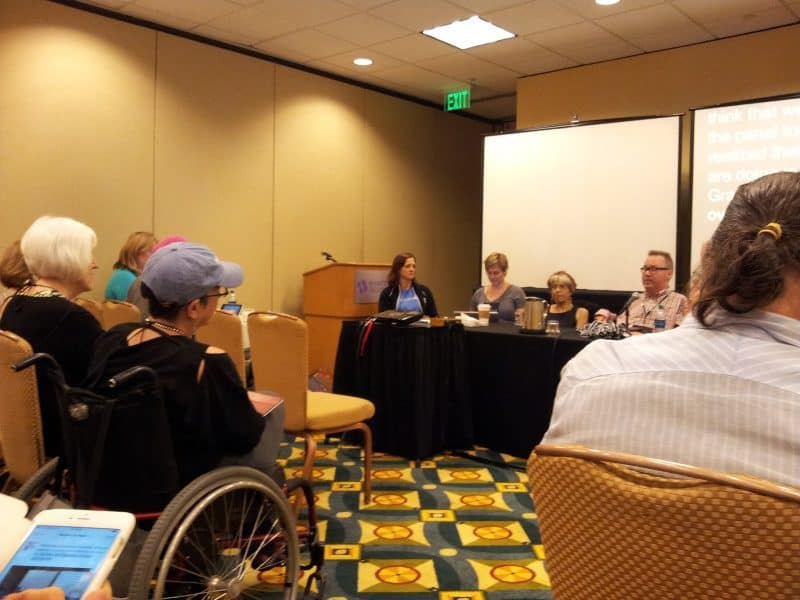
“Disability Arts on Display” panel at Society for Disability Studies Annual Meeting, June 10-13, 2015.
A few weeks ago, hundreds of disability studies scholars, advocates, and activists gathered for the 28th Annual Meeting of the Society for Disability Studies, June 10-13, 2015. I was fortunate to be one of the attendees on behalf of the Library Company, a recent institutional member in the Society as a result of the Common Touch project.
I looked forward to my attendance not only for the multiple sessions related to art and disability, but for the experience of a conference that proactively strove to be as universally accessible as possible. Images for power point presentations needed to be verbally described, closed captioning was standard, and large print copies of presentations were available for distribution.
Through my work with Common Touch project partners, I have become increasingly aware that accessibility standards are a benefit to everyone, disabled or not. Case in point for me at the conference was that more than a few times I glanced at the closed captioning for a word or name I missed while taking notes. Nonetheless, even the most concerted efforts for accessibility can sometimes fall a bit short as did the microphone cords for the Q&A’s. As one disabled panelist noted, even the disabled community can be unintentionally unaccommodating as she asked an audience member, who had vertigo, to come to the front to use the mic.
Not surprisingly, insights also abounded from the subject matter of the panel sessions. The panels on art and disability ranged from dialogues about self-representation of disabled persons in art; the nuts and bolts and challenges/ triumphs of organizing professional Disability Arts festivals; and the social/cultural implications of the stories and relationships pervading the materiality, aesthetics, and concepts of works of art by, depicting, or representing persons with disabilities to the benefits of subjective audio descriptions over objective ones.
To conclude my post, instead of expounding on one or two of the themes from the various panels, I thought I would share some of the snippets and jottings from my notes that continue to resonate with me:
Disability as relationships as opposed to a medical versus social modelIf disability is framed; disability frames usDisability as transformation of “normal” bodyPrivileging disability vs. bridge building through disability in artAn original non-disabled body is non existent
Erika Piola
Associate Curator, Prints and Photographs
Co-director, VCP at LCP
The Library Company of Philadelphia
1314 Locust St., Philadelphia, PA 19107
TEL 215-546-3181 FAX 215-546-5167
http://www.librarycompany.org
1314 Locust St., Philadelphia, PA 19107
TEL 215-546-3181 FAX 215-546-5167
http://www.librarycompany.org
Leave a Reply
Want to join the discussion?Feel free to contribute!