
June/July 2002
Free Classes for Women
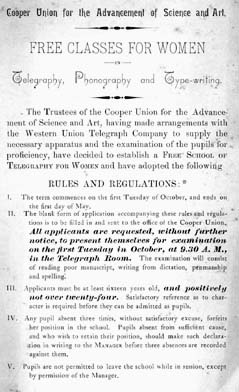
Cooper Union for the Advancement of Science and Art. "Free classes for women in telegraphy, phonography and type-writing." [New York, 1869]
The Library Company recently acquired a copy of the brochure announcing the first term of a free eight-month course in telegraphy for women that Western Union and Cooper Union jointly started in 1869. Located in New York City, Cooper Union for the Advancement of Science and Art was founded in 1859 by Peter Cooper (1791-1883) to provide education to members of the working class. Cooper, himself a workingman's son, had invested part of the fortune he had made previously in glue and iron manufacture in the new industry of telegraphy. Specifically, he was a founding member of the firm that laid the first trans-Atlantic telegraph cable.
The Cooper Union program is particularly interesting in the context of the history of Western Union. By the 1860s, telegraph workers were in oversupply, and mergers in the industry were eliminating jobs. The National Telegraphic Union organized in 1863, and struck against Western Union in January, 1870 (during the first term at Cooper Union). The strike failed after about a week, and Western Union reduced wages in the 1870s.
The young women who learned Morse code for free at Cooper Union often took non-paying jobs after they graduated to gain entrance into the work force, according to Edwin Gabler's The American Telegrapher: A Social History, 1860-1900 (1988). The Cooper Union program, which produced about eighty graduates a year through the early 1890s, probably resulted in greater oversupply of workers, lower wages, and more opposition to working women.
The newly-acquired brochure raises many question. Was this program part of larger efforts to feminize secretarial work (and reduce wages)? Was it an effort to combat the National Telegraphic Union? Also, the brochure stresses that applicants must be young ("positively not over twenty-four") and willing to relocate. Was there a problem finding workers who would relocate? Or, on the other hand, was it conceived as a philanthropic program to train women in marketable skills, and possibly provide them with the opportunity to move away from the city and all its vices? In general, why was such a program begun, given the oversupply of telegraph workers at the time?

Illustration showing male telegraph operator and client, in Industries of the United States (Hartford, 1872), p.[1235].