
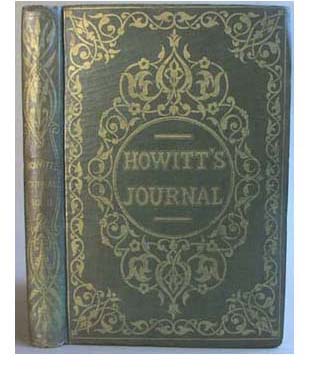
 Howitt's
Journal, vol. 2
Howitt's
Journal, vol. 2
London:William Lovett, 1847.
This month's selection, volume 2 of Howitt's Journal,
(London, 1847) was a generous gift to the Library Company from our friend
and colleague Todd Pattison.
By the time this periodical came out, publishers were commonly using grained bookcloth, (visible in the detail), on economically priced bindings. Introduced in London in the late 1820s, the cheap and sturdy material lended itself to many forms of decoration. Mid nineteenth-century bindings, like this example, often showcased new and experimental decorative effects. Advertisements described this "splendid volume" as "richly bound in green cloth, ornamented with an elegant gold pattern." Splendid it is, as well as fascinating because of the techniques used to bind and decorate its covers.
Typically, cloth bindings were assembled in the following manner. Smooth bookcloth was passed between rollers to receive a texture (or "grain"), such as rib or morocco. Then two pieces of rigid board for the covers of the book, and a strip of heavy paper for the spine, were covered with the grained bookcloth to create a one-piece "case." Designs stamped onto the covers and spine with real gold leaf or in "blind" (without the gold) further decorated the case. Finally, the completed case--the outside-- was attached to the text block--the inside-- to make a book.
Howitt's Journal, however, shows a different technique. The ornaments for the cover of the book were printed in gold ink onto smooth, untextured bookcloth. Next, the printed cloth was grained with a diagonal rib. The boards and spine were covered with the decorated bookcloth, thus creating a completely "pre-ornamented" case; that is, one that could then be attached to the text block without any further decorative treatment.
Periodicals like Howitt's Journal were usually issued in several volumes over a number of years. The use of printed pre-ornamented cloth would have been an efficient way of creating a uniform set, as well as being time saving device. In this case the gold ornaments were printed from a single block which was created specifically for this application. The large, elaborate cover design was undoubtedly expensive to create, but the cost was spread out over the life of the journal, as subsequent volumes were bound up uniformly, using the same printed cloth. Like many experiments, however, this one was not widely adopted. "Splendid volumes" such as this one are all the more outstanding for their rarity and embody the spirit of invention that propelled the evolution of nineteenth century bookbinding.

Detail. Howitt's Journal, vol. 2
London:William Lovett, 1847.